SmogRank / Episodes / South Korea
South Korea, 11 to 12 February 2025
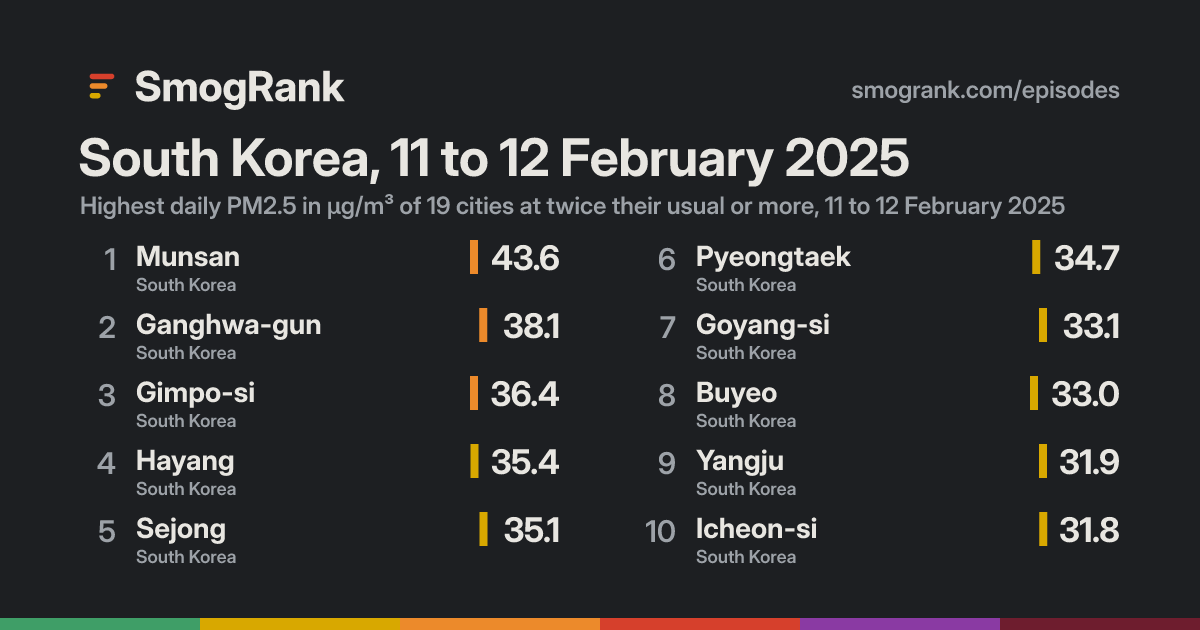
For 2 days, from 11 to 12 February 2025, 19 cities in South Korea had PM2.5 at least twice their usual for the time of year. The worst reading was Munsan, Gyeonggi-do, South Korea: 43.6 µg/m³ on 12 February, about 2.4× its usual 17.8.
No cause named We have no fire or smoke records for these days, so we only say what the measurements show.
Cities reached 19 in 1 country
Days 2 11 to 12 February 2025
Worst day 11 February 16 cities counted
Furthest above usual 2.4× Munsan
Day by day
Play 11 February 16 cities at twice their usual or more
Okcheon Yeongdong Cheongju-si Daejeon Kinzan Jungpyong Koesan Sangju Chinch'ŏn Gimcheon Mungyeong Gongju Chungju Nonsan Yŏnmu Cheonan Jinan-gun Gumi Anseong Seonghwan Asan Changsu Wanju Yecheon Namsa Jeonju Waegwan Iksan Yeoju Yesan Pubal Kunwi Imsil Osan Wŏnju Kimje Yeongju Andong Hongseong Nangen Gunsan Gwangju Yangp'yŏng Neietsu Boryeong Suwon Jeongeup Seongnam-si Tangjin Buan Gyeongsan-si Hanam Kurye Anyang-si Ansan-si Wabu Chinju Hongch’ŏn Hwado Guri-si Damyang Namyangju Gwangmyeong Hadong Seoul Taesal-li Cheongsong gun Koch'ang Miryang Bucheon-si Gapyeong Naesŏ Incheon Jangseong Chuncheon Gwangyang Suncheon Gwangju T’aebaek Hwasun Changwon Masan Goseong Beolgyo Gyeongju Yeonggwang Yeosu Kimhae Yeonil Hwacheon Yanggu Pohang Yangsan Tongyeong Boseong Gangneung Ungsang Sinhyeon Santyoku Donghae City Ulsan Cheorwon Jumunjin Muan Busan Geoje Yeongam Jangheung Gijang Sokcho Mokpo Kosong Haenam Sinan Tsushima Nagato Mine Hagi Onoda Yamaguchi Masuda Hōfu Hamada Gōtsuchō Shūnan Kudamatsu Ōdachō-ōda Ōtake Yanai Iwakuni Yae Hiroshima Gion Kure Higashihiroshima Hwawŏn Changnyeong Daegu Uijeongbu-si Icheon-si Ganghwa-gun Kwangyang Seosan Hwaseong-si Goyang-si Sejong Gimpo-si Yangju Pyeongtaek Naju Eisen Buyeo Hayang Munsan 8 Feb 9 10 11 12 13 14 15 Every measured city in the area, coloured by its PM2.5 that day; a dark ring marks a city at twice its usual or more. Bars: cities counted each day, coloured by their median level. Choose a day or press play; without JavaScript, the days link to that day's world ranking.
How it spread
Munsan Munsan, 8 February: 12.3 µg/m³ Munsan, 9 February: 18.6 µg/m³ Munsan, 10 February: 20.3 µg/m³ Munsan, 11 February: 39.1 µg/m³, 2.2× its usual 17.8 Munsan, 12 February: 43.6 µg/m³, 2.4× its usual 17.8 Munsan, 13 February: 12.2 µg/m³ Munsan, 14 February: 36.0 µg/m³ Munsan, 15 February: 51.7 µg/m³ Gimpo-si Gimpo-si, 8 February: 9.2 µg/m³ Gimpo-si, 9 February: 12.6 µg/m³ Gimpo-si, 10 February: 18.2 µg/m³ Gimpo-si, 11 February: 36.4 µg/m³, 2.1× its usual 17.2 Gimpo-si, 12 February: 35.4 µg/m³, 2.1× its usual 17.2 Gimpo-si, 13 February: 10.6 µg/m³ Gimpo-si, 14 February: 31.0 µg/m³ Gimpo-si, 15 February: 41.1 µg/m³ Sejong Sejong, 8 February: 9.8 µg/m³ Sejong, 9 February: 16.0 µg/m³ Sejong, 10 February: 17.8 µg/m³ Sejong, 11 February: 35.1 µg/m³, 2.1× its usual 16.7 Sejong, 12 February: 34.4 µg/m³, 2.1× its usual 16.7 Sejong, 13 February: 8.1 µg/m³ Sejong, 14 February: 24.9 µg/m³ Sejong, 15 February: 39.6 µg/m³ Pyeongtaek Pyeongtaek, 8 February: 10.8 µg/m³ Pyeongtaek, 9 February: 19.0 µg/m³ Pyeongtaek, 10 February: 20.2 µg/m³ Pyeongtaek, 11 February: 34.7 µg/m³, 2.2× its usual 15.5 Pyeongtaek, 12 February: 28.3 µg/m³ Pyeongtaek, 13 February: 7.5 µg/m³ Pyeongtaek, 14 February: 29.2 µg/m³ Pyeongtaek, 15 February: 46.3 µg/m³ Buyeo Buyeo, 8 February: 9.5 µg/m³ Buyeo, 9 February: 13.6 µg/m³ Buyeo, 10 February: 19.7 µg/m³ Buyeo, 11 February: 33.0 µg/m³, 2.4× its usual 13.5 Buyeo, 12 February: 23.0 µg/m³ Buyeo, 13 February: 10.6 µg/m³ Buyeo, 14 February: 26.4 µg/m³ Buyeo, 15 February: 39.0 µg/m³ Yangju Yangju, 8 February: 10.6 µg/m³ Yangju, 9 February: 14.1 µg/m³ Yangju, 10 February: 17.2 µg/m³ Yangju, 11 February: 31.9 µg/m³, 2.2× its usual 14.7 Yangju, 12 February: 29.7 µg/m³, 2.0× its usual 14.7 Yangju, 13 February: 7.3 µg/m³ Yangju, 14 February: 32.5 µg/m³ Yangju, 15 February: 41.6 µg/m³ Icheon-si Icheon-si, 8 February: 8.6 µg/m³ Icheon-si, 9 February: 17.2 µg/m³ Icheon-si, 10 February: 19.8 µg/m³ Icheon-si, 11 February: 31.8 µg/m³, 2.0× its usual 15.6 Icheon-si, 12 February: 29.8 µg/m³ Icheon-si, 13 February: 7.2 µg/m³ Icheon-si, 14 February: 30.6 µg/m³ Icheon-si, 15 February: 58.7 µg/m³ Uijeongbu-si Uijeongbu-si, 8 February: 10.0 µg/m³ Uijeongbu-si, 9 February: 13.8 µg/m³ Uijeongbu-si, 10 February: 14.9 µg/m³ Uijeongbu-si, 11 February: 31.2 µg/m³, 2.0× its usual 15.5 Uijeongbu-si, 12 February: 27.9 µg/m³ Uijeongbu-si, 13 February: 8.2 µg/m³ Uijeongbu-si, 14 February: 32.6 µg/m³ Uijeongbu-si, 15 February: 42.6 µg/m³ Hwaseong-si Hwaseong-si, 8 February: 5.3 µg/m³ Hwaseong-si, 9 February: 9.6 µg/m³ Hwaseong-si, 10 February: 14.2 µg/m³ Hwaseong-si, 11 February: 29.9 µg/m³, 2.1× its usual 14.4 Hwaseong-si, 12 February: 24.4 µg/m³ Hwaseong-si, 13 February: 7.4 µg/m³ Hwaseong-si, 14 February: 29.9 µg/m³ Hwaseong-si, 15 February: 43.4 µg/m³ Hayang Hayang, 8 February: 8.8 µg/m³ Hayang, 9 February: 11.1 µg/m³ Hayang, 10 February: 14.9 µg/m³ Hayang, 11 February: 29.5 µg/m³, 2.0× its usual 14.7 Hayang, 12 February: 35.4 µg/m³, 2.4× its usual 14.7 Hayang, 13 February: 6.8 µg/m³ Hayang, 14 February: 20.0 µg/m³ Hayang, 15 February: 35.8 µg/m³ Seosan Seosan, 8 February: 7.4 µg/m³ Seosan, 9 February: 10.4 µg/m³ Seosan, 10 February: 15.0 µg/m³ Seosan, 11 February: 29.5 µg/m³, 2.1× its usual 13.9 Seosan, 12 February: 19.5 µg/m³ Seosan, 13 February: 9.9 µg/m³ Seosan, 14 February: 27.0 µg/m³ Seosan, 15 February: 30.8 µg/m³ Daegu Daegu, 8 February: 9.2 µg/m³ Daegu, 9 February: 10.3 µg/m³ Daegu, 10 February: 16.6 µg/m³ Daegu, 11 February: 28.4 µg/m³, 2.0× its usual 14.0 Daegu, 12 February: 25.3 µg/m³ Daegu, 13 February: 8.5 µg/m³ Daegu, 14 February: 23.0 µg/m³ Daegu, 15 February: 37.3 µg/m³ Naju Naju, 8 February: 12.2 µg/m³ Naju, 9 February: 10.7 µg/m³ Naju, 10 February: 20.3 µg/m³ Naju, 11 February: 28.2 µg/m³, 2.3× its usual 12.5 Naju, 12 February: 15.6 µg/m³ Naju, 13 February: 10.0 µg/m³ Naju, 14 February: 16.7 µg/m³ Naju, 15 February: 31.5 µg/m³ Eisen Eisen, 8 February: 5.0 µg/m³ Eisen, 9 February: 6.4 µg/m³ Eisen, 10 February: 11.9 µg/m³ Eisen, 11 February: 27.6 µg/m³, 2.4× its usual 11.6 Eisen, 12 February: 25.8 µg/m³, 2.2× its usual 11.5 Eisen, 13 February: 4.5 µg/m³ Eisen, 14 February: 15.7 µg/m³ Eisen, 15 February: 31.9 µg/m³ Kwangyang Kwangyang, 8 February: 8.0 µg/m³ Kwangyang, 9 February: 7.9 µg/m³ Kwangyang, 10 February: 12.9 µg/m³ Kwangyang, 11 February: 25.0 µg/m³, 2.1× its usual 11.9 Kwangyang, 12 February: 16.8 µg/m³ Kwangyang, 13 February: 6.9 µg/m³ Kwangyang, 14 February: 16.4 µg/m³ Kwangyang, 15 February: 31.6 µg/m³ Hwawŏn Hwawŏn, 8 February: 7.8 µg/m³ Hwawŏn, 9 February: 9.5 µg/m³ Hwawŏn, 10 February: 13.7 µg/m³ Hwawŏn, 11 February: 25.0 µg/m³, 2.0× its usual 12.3 Hwawŏn, 12 February: 23.9 µg/m³ Hwawŏn, 13 February: 7.3 µg/m³ Hwawŏn, 14 February: 19.9 µg/m³ Hwawŏn, 15 February: 34.9 µg/m³ Ganghwa-gun Ganghwa-gun, 8 February: 9.9 µg/m³ Ganghwa-gun, 9 February: 15.4 µg/m³ Ganghwa-gun, 10 February: 20.6 µg/m³ Ganghwa-gun, 11 February: 37.7 µg/m³ Ganghwa-gun, 12 February: 38.1 µg/m³, 2.0× its usual 19.0 Ganghwa-gun, 13 February: 11.1 µg/m³ Ganghwa-gun, 14 February: 30.6 µg/m³ Ganghwa-gun, 15 February: 35.6 µg/m³ Goyang-si Goyang-si, 8 February: 7.6 µg/m³ Goyang-si, 9 February: 12.1 µg/m³ Goyang-si, 10 February: 16.3 µg/m³ Goyang-si, 11 February: 31.5 µg/m³ Goyang-si, 12 February: 33.1 µg/m³, 2.1× its usual 15.9 Goyang-si, 13 February: 7.4 µg/m³ Goyang-si, 14 February: 31.6 µg/m³ Goyang-si, 15 February: 40.9 µg/m³ Changnyeong Changnyeong, 8 February: 7.0 µg/m³ Changnyeong, 9 February: 9.5 µg/m³ Changnyeong, 10 February: 12.9 µg/m³ Changnyeong, 11 February: 23.0 µg/m³ Changnyeong, 12 February: 27.2 µg/m³, 2.0× its usual 13.3 Changnyeong, 13 February: 6.4 µg/m³ Changnyeong, 14 February: 18.7 µg/m³ Changnyeong, 15 February: 30.3 µg/m³ 8 Feb 9 10 11 12 13 14 15 Every counted city, in the order the episode reached them, 3 days before to 3 after. Each square is a day, coloured by that day's PM2.5; outlined: at twice the city's usual or more. Good 0–50
Moderate 51–100
Sensitive groups 101–150
Unhealthy 151–200
Very unhealthy 201–300
Hazardous 301+
Every city it reached
City Days Highest Usual Above usual
Munsan Gyeonggi-do, South Korea 2 12 February 17.8 2.4× Hayang Gyeongsangbuk-do, South Korea 2 12 February 14.7 2.4× Buyeo Chungcheongnam-do, South Korea 1 11 February 13.5 2.4× Eisen Gyeongsangbuk-do, South Korea 2 11 February 11.6 2.4× Naju Jeollanam-do, South Korea 1 11 February 12.5 2.3× Pyeongtaek Gyeonggi-do, South Korea 1 11 February 15.5 2.2× Yangju Gyeonggi-do, South Korea 2 11 February 14.7 2.2× Gimpo-si Gyeonggi-do, South Korea 2 11 February 17.2 2.1× Sejong Sejong-si, South Korea 2 11 February 16.7 2.1× Goyang-si Gyeonggi-do, South Korea 1 12 February 15.9 2.1× Hwaseong-si Gyeonggi-do, South Korea 1 11 February 14.4 2.1× Seosan Chungcheongnam-do, South Korea 1 11 February 13.9 2.1× Kwangyang Jeollanam-do, South Korea 1 11 February 11.9 2.1× Ganghwa-gun Incheon, South Korea 1 12 February 19.0 2.0× Icheon-si Gyeonggi-do, South Korea 1 11 February 15.6 2.0× Uijeongbu-si Gyeonggi-do, South Korea 1 11 February 15.5 2.0× Daegu Daegu, South Korea 1 11 February 14.0 2.0× Changnyeong Gyeongsangnam-do, South Korea 1 12 February 13.3 2.0× Hwawŏn Daegu, South Korea 1 11 February 12.3 2.0×
Daily means in µg/m³, over the days each city counted in this episode. Highest: its highest of those days. Usual: the city's median for the time of year of that day (its days within 21 days of the date, every year, leaving out the week around it). Above usual: its highest day against that, with a usual under 5 µg/m³ taken as 5.
Against other episodes in South Korea
Number 48 of 63 episodes in South Korea since our records began, by cities reached.
Japan and South Korea, March 2025 454 Japan and South Korea, March 2026 305 Japan and South Korea, January 2025 274 Japan and South Korea, February and March 2025 192 South Korea and Japan, January 2026 169 South Korea and Japan, 10 to 15 February 2026 147 South Korea, 14 to 16 February 2025 132 South Korea and Japan, November 2025 128 South Korea, February 2026 121 South Korea, 7 December 2025 113 South Korea, 13 to 14 January 2025 113 South Korea, 16 to 20 December 2025 107 South Korea, 11 to 12 February 2025 19 Bars: cities reached; colour: the level of the episode's highest daily reading. All 63 .
Use this page SmogRank, South Korea, 11 to 12 February 2025: 19 cities with PM2.5 at twice their usual or more, 11 to 12 February 2025, smogrank.com/episodes/2025-02-11-south-korea (accessed 4 October 2026).
Copy citation Download top 10 (PNG)
You're welcome to reuse a single chart, image or figure with this citation and a link. Terms .
An episode is a run of days when many cities close to each other (four or more within 350 km on a day, 8 or more in all) each had a daily PM2.5 mean of at least 25 µg/m³ and at least 2 times their usual for that time of year. Found in our own measurements, not picked by hand. How we find episodes . Values are each city's daily mean of its own monitors; causes are the usual kinds for a pattern like this, not a confirmed source.